GOOD THAI WINE
Thrice! Three times on my recent vacation I had disposed of
That's a record. In my travels I have imbibed dreaded Mekong whiskey, Cambodian muscle wine, the most wretched of sojus, African moonshine and various Kuwaiti homemade-concoctions that involved no small number of health risks. But never have I found so many undrinkable brews as I did on my most recent trip.
The first and the worst was the dreaded Lihing rice wine of Malaysian Borneo. The craft shop attendant said it could be used for either cooking or drinking. “How is it best served?,” I asked. She looked at me puzzled – as if nobody had ever before considered drinking it.
Later, I opened the small plastic bottle to discover a scent somewhere between nail polish remover and an open sewer. I poured two glasses, one which was promptly refused by my more-sensible companion. I sipped it. and I then spent about five minutes inadvertently talking like Jerry Lewis from one of his earlier films (Waaugh Dean! Help me Dean!).
I quickly decided that the vile liquid was best flushed.

The evil Lihing No 1 is even autographed
The second two vile liquids were better by comparison, and were I desperate they may have even been something I would finish. The first was a Thai cabernet sauvignon of no notable vintage or vineyard. It tasted like a watered-down port. It may have been tolerable in that it wouldn't have prompted illness or my earlier Jerry Lewis-like fit of distaste. However, I decided I had no urge to drink exceptionally bad wine so I donated it to a friend who was sampling an exceptionally tasteless Thai chardonnay.
I should have realized that the Thai Beer was a bad idea due to its attempt to mimic an American Budwiser label. If it were any good, surely, it would try to ape a better beer than Budwiser.
Alas, it was simply vile. Thai Beers – the most notable being Singha and Chang – are never anything to write home about. But Thai Beer was exceptionally grim.

The evil Thai Beer
Stronger in alcohol than its better-known counterparts, it tasted like one of the worst 'super' lagers but with the added grossness of extra sweetener. It was as if an extra tablespoon of sugar had been stirred in. Disgusted, I passed on the bottle to a gentleman selling fake watches at Karon Beach.
Being thoroughly disappointed at the range of alcohol in Borneo and Phuket (where a evil insane bartender had also decided that a maraschino cherry would make an excellent substitute for an cocktail olive in my Gibson Martini, yearrgh!) I set off to Bangkok.
There I was surprised to find a thoroughly drinkable and surpassingly good Thai herbal wine. Thailand's Boss Lake Hills deserves full praise for its Black Rhizomes Red Wine.
I was skeptical at first. The wine was predominantly pineapple based and teenage memories of Boone's have left me permanently wary of fruit wines. I was even more concerned when the waiter started laughing at me after I had bought the bottle to my table.
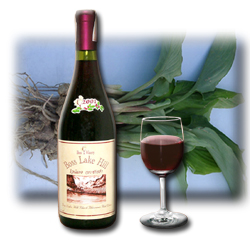
The delightful Black Rhizomes Red Wine
I sipped it and suggested that it wasn't that bad.
He laughed uncontrollably.
It was similar to a dry red grape-based wine, with slight hints of cloves and Christmas spices. I told him that. He laughed even more uncontrollably.
Eventually, the waitress came to the table and apologized for her colleague. She said that he was laughing because black rhizome wine was a well-known Thai aphrodisiac.
More specifically, she said, “that wine make you either have sex or spank monkey!”
I noted that the bottle simply claimed that it aided digestion. And further noted that Asians think everything is an aphrodisiac: dog soup, tiger or seal penises, rhino horns, live mudskippers... whatever.
Nevertheless, given the awful alcohol that I had to deal with, the wine was worthy of an endorsement. It tasted like a mid-range valpolicella but with spicier notes. The hue was closer to rosé or a very light red. It had notes of Christmas spices and a warming feel to it, similar to a cooled-down mulled wine.
It was not available at duty free, however, so I did not get to see whether it would make Lisa want to have sex.
Still, all in all, black rhizones red was monkey-spanking good.
posted by Myrick at 10:55:00 PM


<< Home